
What Enterprise Brands Actually Want From a Braze Agency in 2026

The marketing stack got a promotion.
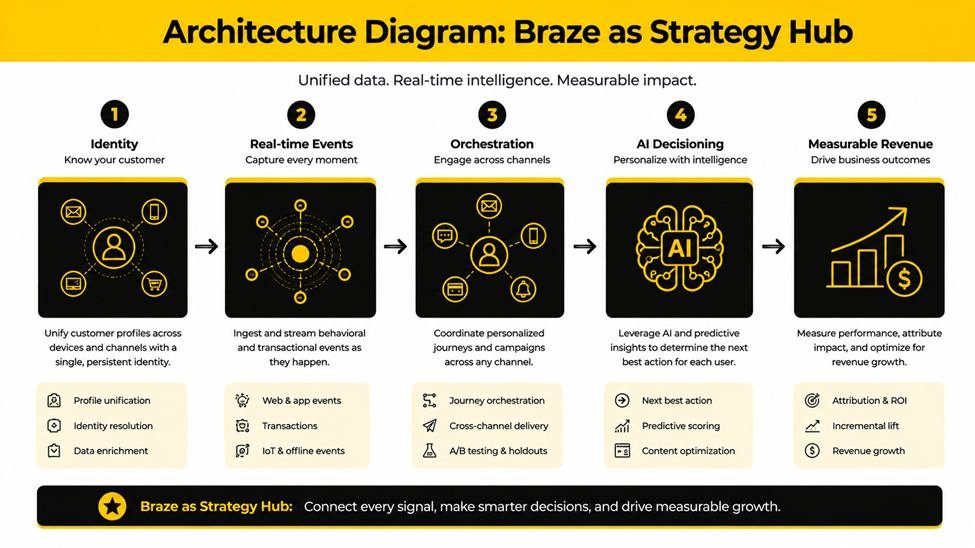
Braze is no longer just the place where campaigns are sent. It is where real-time customer data, journey logic, and AI decisioning collide.
And Braze’s own 2026 research shows the gap remains wide: only 55% of marketers update customer information in real time, while only 33% say content is assembled for each user at the moment of engagement.
That is why enterprise buyers are rethinking agency relationships.
They do not want another vendor that sends pretty emails and reports on opens. They want a Braze agency that behaves like a strategy hub: transparent about AI, serious about data portability, and capable of building automation-ready models that turn Braze into a decision engine.
The pressure is obvious. If your team cannot activate context in real time, Braze becomes a very expensive newsletter machine.
Let’s cut to the chase.
Table of Contents
|
1. Why are enterprise brands shifting from in-house teams to agencies? 2. What are the 4 core expectations from a modern Braze agency? 3. Traditional vendor vs. 2026 strategy hub: what is the difference? 4. How does a specialized agency accelerate time-to-value? 5. Wrapping up |
Why are enterprise brands shifting from in-house teams to agencies?
Enterprise brands are increasingly moving toward specialized agencies for one reason: flexibility.
In-house hiring often locks companies into narrow skill sets. Agencies bring cross-functional expertise that scales faster, without inflating overhead. And the problem with internal hiring is painfully familiar.
You hire for one role. Then the strategy changes. Suddenly, the team built for paid media is expected to manage lifecycle journeys, omnichannel orchestration, and AI-driven experimentation.
The market evolves faster than org charts do.
That is where in-house models get sticky. They are not bad. They are just limited by the skill set you already have.
Braze is built on real-time data activation, cross-channel orchestration, and AI decisioning, which means the platform rewards teams that understand systems, not just sends.
Braze’s product and docs emphasize streaming data, Canvas journeys, Currents, and decisioning layers; those are not “nice to have” features, they are architecture choices.
The agency advantage is speed without lock-in. A specialized partner can rotate in the right strategist, data modeler, and technical lead as the work changes, rather than asking one person to be brilliant at everything.
And in 2026, that matters more than ever. Brands want execution, yes. But they also want a partner who can show where the stack is headed before they spend a quarter chasing the wrong problem.
What are the 4 core expectations from a modern Braze agency?
In 2026, enterprise brands expect agencies to provide data portability, transparent AI usage, automation-ready data models, and proactive strategic guidance.
1. Complete data and tech portability
Brands are done with agency babysitting. If the relationship ends, they want their data, workflows, and historical learning to leave with them.
That is not paranoia. That is governance. Braze supports real-time data movement through Currents and export tooling, which means the architecture can be designed for portability rather than dependencies.
2. Transparent and tested AI integration
AI without transparency is just fast guessing. Enterprise brands want clarity before automation. They want to understand what the model is doing, where it learns from, and which decisions still stay under human control.
BrazeAI Decisioning Studio runs on reinforcement learning and continuous optimization. BrazeAI Operator adds a natural-language layer for setup, troubleshooting, and campaign execution.
Powerful? Absolutely. But the real value only appears when the agency can explain the logic behind the machine, not just deploy it.
3. Cross-channel orchestration and data modeling
Braze Canvas is not a template builder. It is a journey system built around Action Paths, Audience Paths, Experiment Paths, and context-aware branching. A serious agency has to model the data first, then design the experience.
4. Proactive strategic partnership
The best agencies do not wait for a brief. They bring points of view.
In practice, that means flagging emerging channels, highlighting gaps in the customer journey, and telling the brand when the stack is ready for more AI or when the data foundation is still too soft.
A vendor executes the brief.
A strategy hub challenges it, sharpens it, and sometimes rewrites it.
Traditional vendor vs. 2026 strategy hub: what is the difference?
Traditional vendors focus on siloed execution and vanity metrics, while a modern Braze strategy hub owns cross-channel outcomes, AI transparency, and data portability.
| Capability | Traditional Marketing Vendor | 2026 Braze Strategy Hub |
| Operational Focus | Executes siloed, single-channel campaigns. | Operates as a strategy and execution hub across channels. |
| AI Utilization | Uses AI casually, often to speed up a weak strategy. | Pressure-tests AI and explains where it is used and where it is not. |
| Reporting & Metrics | Reports open rates, clicks, and activity volume. | Connects work to LTV, CAC payback, retention, and revenue. |
| Data Ownership | Historical learning often lives with the vendor. | The brand owns the data, workflows, and transition path. |
That is the divide in one view. One model ships work. The other owns the system.
How does a specialized agency accelerate time-to-value?
A certified Braze agency accelerates time-to-value by implementing the platform with clean data models, direct measurement frameworks, and proven omnichannel architecture from day one.
Speed matters, but not the fake kind. Not “we launched fast.” More like “we launched correctly, and now the data actually means something.”
Braze’s stack is designed for real-time activation, but it still needs a strong identity model, clean event structure, and routing logic before anything intelligent can happen. That is why agencies spend their first energy on implementation quality, not just campaign volume.
The payoff is measurable. That’s the whole point. A good partner does not just get you live. It gets you paying attention to the right numbers.
Wrapping up
That brings us to the business end of this article, where it’s fair to say that enterprise brands in 2026 want more than campaign execution.
They want transparent AI, portable data, and a partner that can turn Braze into a real-time strategy layer, not just a messaging tool.
The ball is in your yard now. It’s time to make every effort count.
